The Great Centrifuge · ch 03
The Five Blurred Layers
The Age of Information: From Three Discrete Classes to Five Blurred Layers
In addition to further accelerating the spin, the Information Age changed the dynamics in a few, very important ways:
Geography disconnected from top-end services: People started looking for the global best expert or product, not the best locally available.
Geography disconnected from global renown: You can become famous anywhere, online.
Specialized communities connected with each other globally: The pioneers in any field were suddenly within reach of each other, leading to them having a compounding advantage against everyone else in their field — if they were good enough to earn their membership.
Social networks created positive reinforcement loops: Crossing a certain threshold of popularity makes you more likely to cross the next one, not less.
Early-stage capital separated from the aristocracy: tech venture capital emerged and startups paid in equity, not just cash.
Global winners emerged: For the first time, companies could ‘win’ at their field globally, not just in their home company or market. Google won search.
Social systems diverged: Different western economies started treating critical necessities — like healthcare and education — very differently. Some kept them as human rights, and some put them behind a paywall. This tilted the spin differently in different countries.
The gig economy: Many professions were separated, by technology, from stable employment, and paid by the task instead of by the hour, week, or month.
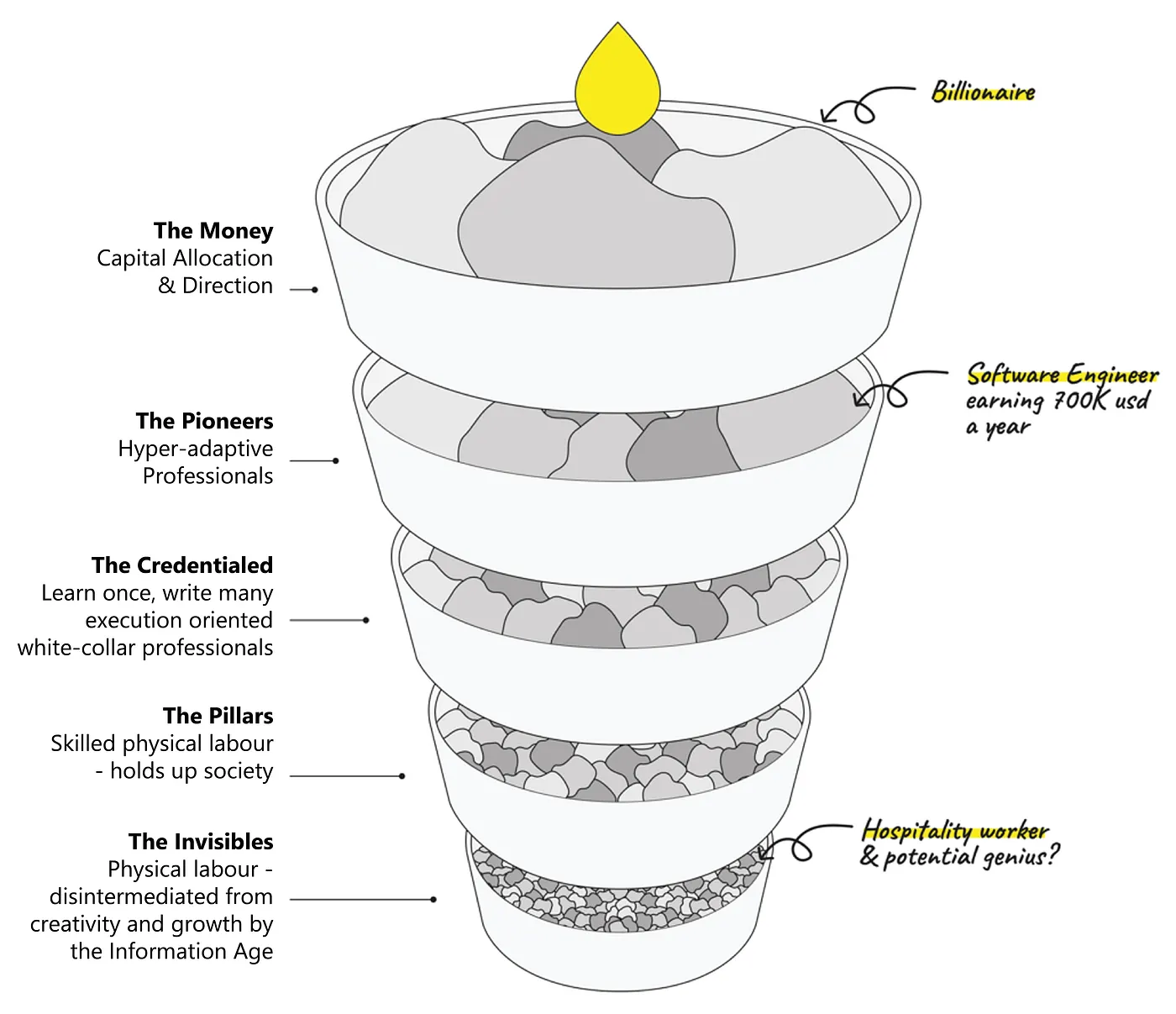
These made the centrifuge not only spin faster, but have separated working society into five ‘layers’, which merge and flow together, rather than three discrete classes:
-
The Money: Capital aggregators. People who primarily make money by having money — structurally separated from the labor system, but essential to its function. At global scale, capital allocation becomes the only viable mechanism to organize complexity. Not just billionaires — but venture capitalists, sovereign wealth managers, asset allocators, and founders who’ve escaped the need to earn through effort. Anyone who’s crossed the threshold where capital compounds faster than labor, and participation becomes optional. Ring 0.
-
The Pioneers: Adaptive professionals. People who don’t just copy, they make new ideas and push boundaries, participating in the global community of their craft. Always learning, moving, rising. Teaching and sharing.
-
The Credentialed: Execution-oriented white-collar professionals. People who invested a lot of time and effort ‘up front’ in learning a complex profession and then expected those skills to last a lifetime. Essential to running complex systems, but increasingly fragile and resistant to change. Depending on what country they live in, and what profession they picked, they may no longer receive the return on their investment for their tertiary education.
-
The Pillars: The people who shape the physical world and care for others. Builders, mechanics, electricians, nurses, carers, logistics workers. They move matter and sustain life. Without them, none of the other classes would function — they’re the pillars of our societies. They generate enormous social value that markets consistently fail to price. But within their professions, upward mobility still exists — driven by skill, reputation, and trust.
-
The Invisibles: People displaced from stable employment and separated from the protections that it provides, while still doing the same job — e.g., the gig economy. Largely overworked and paid by the task, algorithms, which enforce minimum standards but do not reward excellence, have removed much of their autonomy as well as upward mobility. Very little opportunity for mentorship — any professional growth would have to occur in addition to the mountain of gigs. If the Pillars are holding up society, the Invisibles are the mantle: essential, and with the potential to erupt if the pressure continues to build.