The Great Centrifuge · ch 01
Why I Care, and The Balance
Who I Am, and Why I Care so Much about Skills & Social Mobility
I was raised by an amazing mother — a single parent, below the poverty line, in a poor town in Australia.
A country known for being lucky.
I now lead Engineering and Innovation for Commonwealth Bank of Australia, where I’ve worked for nearly half my life.
I had two strokes of real luck.
The first was being gifted a computer at age five.
I learned to code because I couldn’t afford software.
Then I learned to hack — because I couldn’t afford the internet.
I had to figure out how to get it for free.
And in doing so, I got to meet some of the best hackers in the world — in the U.S., Russia, Europe, and China.
Some had it better than me. Most had it worse.
And I saw something very clearly:
There’s less correlation between someone’s talent or character and the quality of their life than most people think. We’ve made huge progress towards merit-based equality, but we have a long way to go.
Luck — who your parents are, and where you’re born — still plays a huge role.
That’s why I spend so much of my personal time trying to support free and open technology education, and it’s also why I care so much about what comes next: Because for once, we might have a shot at making the system fairer and more stable, not just faster.
My second big stroke of luck — and this is a weird thing to say — was having cancer. Twice.
Bone cancer at 16, and pancreatic at 32.
When you think you’re at the end of your life, you care a lot less about your title and your bank balance — and a lot more about how you treated people, and whether you’re leaving a better world behind.
The biggest gift, though, was time: months to reflect on what matters, to absorb big ideas, and to observe how people treat each other — what drives them to do their best, and where the fault lines lie. What makes people stronger, and what causes them to break.
Individually and Collectively.
The Balance: How Advances in Technology cause Social Disorder
I think we can measure a global civilization according to its ability to do just three things:
Its ability to calculate — to measure things and make predictions
Its ability to create things — to manipulate matter
Its ability to organize itself — to do things at scale and with cohesion
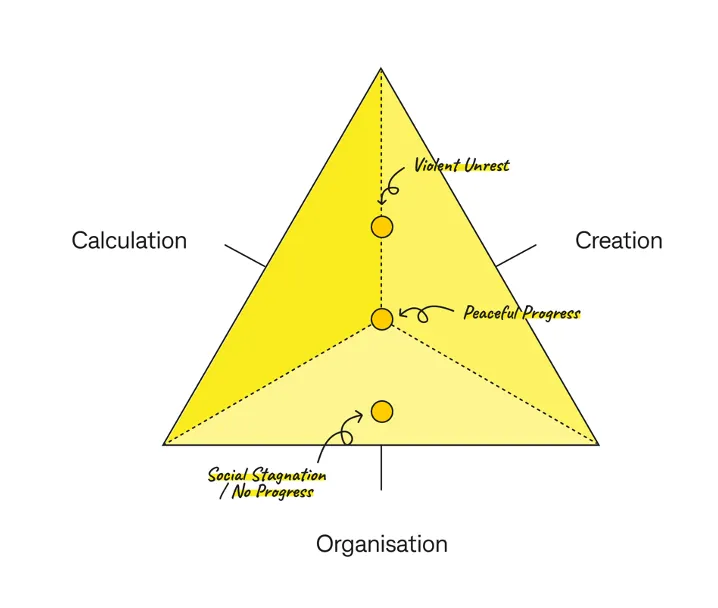
When these three evolve together, we thrive. When they get out of sync, a bit, society strains. When they diverge, society can collapse.
I believe, when it comes to our ability to organize society, we have always just established enough to survive, as technology evolves and pushes us forward.
And when we fail to organize ourselves well, it’s not just ideas that get lost: it’s people.